Exosome therapy, in a medical-spa setting, means applying a concentrated cell-signalling complex to skin that has just been opened by microneedling — so the question of what exosome therapy actually is has a simple answer: it is a delivery-assisted topical, not an injection and not a stem-cell treatment. At IPL Lab our exosomes Montreal program uses these complexes exclusively as topicals layered into a microneedling session. Nothing is injected, because no exosome product is approved for injection in Canada or the United States. This article explains what the evidence supports, which complexes we use and where they come from, what a course realistically changes, and what it costs.
“Exosomes are an enhancer, not an engine. The needling builds the collagen — the complex changes how comfortably you get there and how well the skin recovers.”The IPL Lab skin-booster philosophy
✦ The short answer
Exosomes are tiny vesicles cells use to send signals to other cells. In aesthetics they are used as a topical concentrate, applied during and after microneedling so the channels help them penetrate. The evidence is early but encouraging — mostly preclinical work and small case series, with reviews calling for larger trials; PRP still has the stronger randomised-trial base. No exosome product is approved for injection in Canada or the US, and we never inject them. Expect 3–6 sessions about four weeks apart, from $150–$300 per session depending on the complex.
What this article covers
What exactly are exosomes?
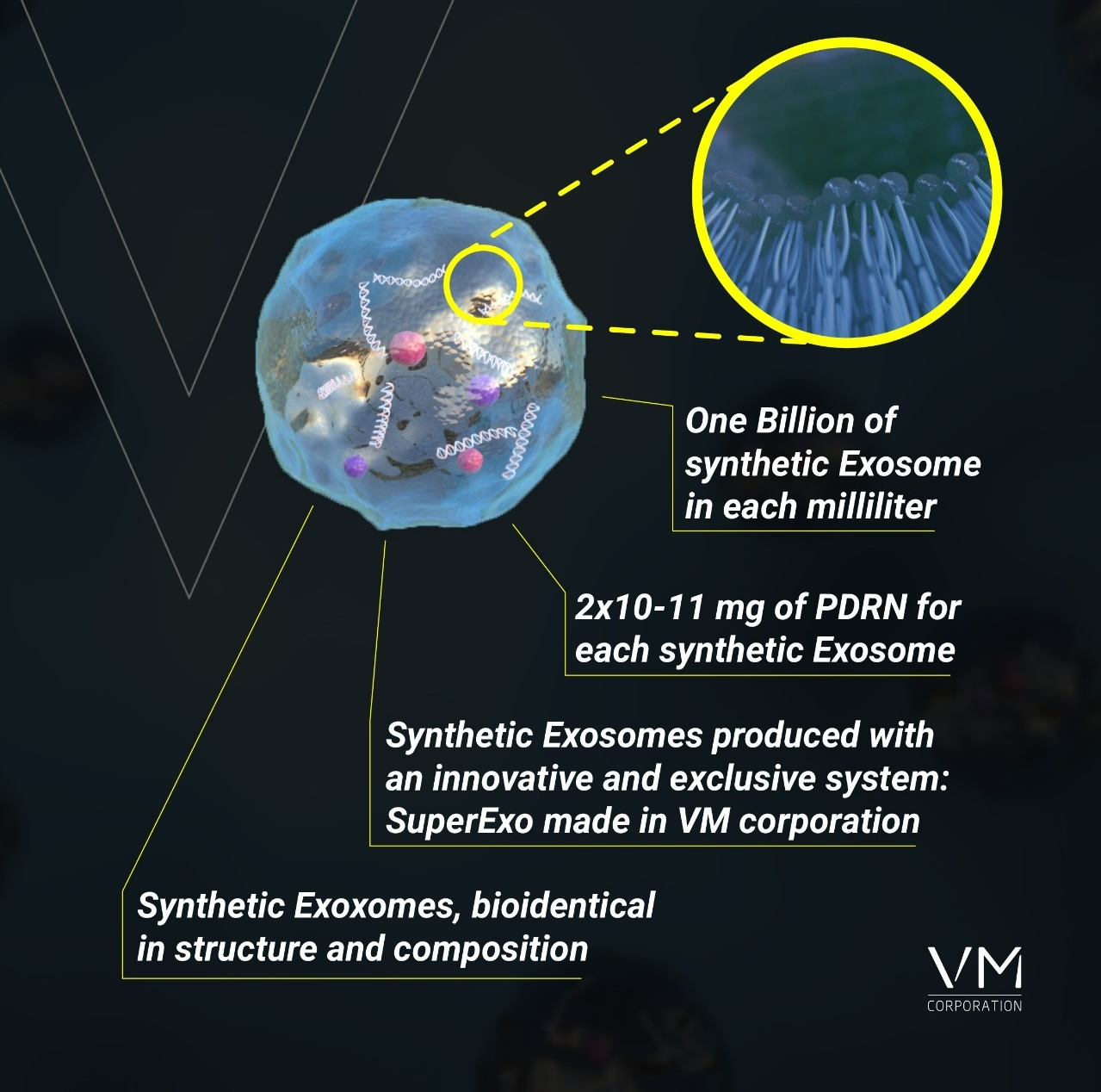
Exosomes are extremely small membrane-bound vesicles — roughly 30 to 150 nanometres across — that cells release into their surroundings. Their job is communication. Each vesicle carries a cargo of proteins, lipids and RNA fragments, and when a neighbouring cell takes that cargo up, its behaviour shifts a little. In skin, the cells of interest are fibroblasts, the cells that produce collagen and elastin.
Two clarifications matter more than anything else here. An exosome complex is not a stem cell treatment: there are no living cells in the bottle, only the signalling packages cells left behind. And a cosmetic exosome complex is a manufactured, purified ingredient, not a biological transplant. That distinction is what keeps a topical complex on the cosmetic side of the regulatory line.
A signal, not a cell
Vesicles carrying protein and RNA cargo. No living cells are involved at any stage, which is the most common misunderstanding we correct at consultation.
Aimed at fibroblasts
The intent is to nudge collagen-producing cells that the needling has already stimulated — an amplifier on a signal the treatment itself creates.
Delivered topically
Intact skin is a good barrier against particles this size. Microneedling channels are what make a topical complex worth applying at all.

Are exosomes injected, or applied to the skin?
At IPL Lab, applied to the skin — always, without exception. The complex goes on while the microchannels created by the needling are still open, and again as a post-treatment layer. Some clinics elsewhere inject exosome preparations. We do not, and the reason is not squeamishness: injection moves the product out of the cosmetic category entirely and into territory where no approved product exists.
This is also where nearly all of the serious adverse events reported in the field have come from. The infections and inflammatory reactions that make the news overwhelmingly involve injected preparations, often from providers working outside any regulatory framework, sometimes with products of unverifiable origin. Topical application onto freshly needled skin carries the ordinary risks of RF microneedling and needling in general, which are well characterised and manageable.
What we do — topical, needling-assisted
Cosmetic-grade complex applied during and after the session. Appearance and feel claims only. Sits squarely inside Canadian cosmetic regulation.
What we never do — inject
No injected exosomes, no “exosome shots”, no intradermal delivery. If a clinic offers this, ask which approved product they are using — there isn’t one.
Are exosomes approved by Health Canada or the FDA?
Not for injection or for treating any condition — and this is worth stating plainly rather than burying. The FDA’s own consumer alert on regenerative medicine products confirms there are currently no FDA-approved exosome products, and that exosome products intended to treat diseases or conditions generally require approval. In Canada, the relevant framework is Health Canada’s cosmetic–drug interface, and it is unusually explicit: to be a cosmetic, a product must act superficially without percutaneous absorption, and products administered by injection are not considered cosmetics at all.
What that means for you as a client is straightforward. A topical exosome complex used in a facial or needling session is a legitimate cosmetic ingredient. An “exosome injection” advertised as treating a medical condition is not an approved therapy, wherever it is offered.
So is what IPL Lab does legal and above board?
Why do some clinics advertise exosome injections then?
Does “cosmetic” mean it does nothing?
You can read the FDA’s position directly in its consumer alert on regenerative medicine products, and Health Canada’s classification logic in its guidance on the cosmetic–drug interface.
What does the evidence actually show?
Honestly: promise, not proof. The laboratory work is genuinely interesting — exosome preparations do measurably influence fibroblast behaviour in cell culture and in animal models of wound healing. The human clinical literature is thinner: mostly small case series and open-label studies, frequently without a control arm, often reporting outcomes that improve alongside the needling the exosomes were applied with. Systematic reviews published through early 2026 read the same way, describing encouraging signals and then calling for adequately powered randomised trials.
Set against that, platelet-rich plasma has a substantially stronger randomised-controlled-trial base for skin and hair applications. If someone tells you exosomes are proven superior to PRP, they are ahead of the data. What we can say from our own before and after documentation is that clients tolerate boosted sessions comfortably and recover quickly, which is a real benefit even where the collagen question stays open.
Which boosters go into a session, and what does each one do?
A booster is chosen for the skin in front of us, not sold as a fixed tier. We work with Korean and Italian sourced complexes and a small set of well-understood supporting actives, and we will say openly which ones have real evidence behind them and which are newer than their marketing suggests.
Korean exosome complexes
Cosmetic-grade topical concentrates from Korean laboratories — the segment driving most current formulation work. Applied topically only.
V-Tech by Promoitalia
Our premium Italian exosome complex, from Promoitalia. It is the top tier of our booster menu and priced accordingly. Italian, not Korean — a detail often reported wrongly.
PDRN
Polydeoxyribonucleotide — salmon-derived DNA fragments, used topically for a soothing, hydrated finish. Far milder than injectable PDRN, and not vegan.
Topical PLLA
A collagen-support ingredient in topical form. This is not the physician-administered PLLA injectable filler — same molecule, entirely different procedure and effect.
NAD+
A cellular-energy coenzyme and the newest addition here. Topically it is the least studied ingredient on this list, and we present it that way.
Rejuvenating polypeptides
The best-understood and most reliable option in the whole stack. If you want the least speculative booster, this is it — and it is also the most affordable.
Brightening polypeptides
A complex aimed at uneven tone and dullness, useful alongside our skin brightening work rather than instead of it.
GHK-Cu
A copper tripeptide with a long history as a cosmetic ingredient, studied for its role in skin-repair and remodelling signalling. A well-established supporting active.
Where the complex comes from is not brand theatre — it determines what documentation exists behind the bottle. The two sources we work with have different characters, and there are questions any clinic should be able to answer about either.
Korean complexes — formulation-led. Korea’s cosmetic sector moves faster than any other on booster formulation, and most of the topical exosome innovation of the last few years has come from there. The strength is refinement and cosmetic elegance: complexes that layer well, absorb quickly and pair sensibly with polypeptides and PDRN. Worth knowing: “Korean exosomes” is a category, not a brand, and quality across it varies considerably.
V-Tech by Promoitalia — the premium tier. An Italian complex from Promoitalia, and the most expensive booster we offer. We use it where a client wants the strongest formulation on our menu for a full-face rejuvenation course. One correction we make often: V-Tech is Italian and has no connection to VT Cosmetics, the Korean K-beauty brand behind Reedle Shot spicules — similar names, unrelated companies.
Three questions for any clinic. First: is it applied topically or injected? Topical is the only answer that sits inside Canadian cosmetic regulation. Second: what is the product and who manufactures it? A clinic that cannot name the source should not be putting it on your skin. Third: what is being claimed? Appearance and feel are fair; treating a condition is not.
Whichever combination we land on, the honest framing stays the same: boosters improve comfort, recovery and overall skin quality, but the needling itself is what builds collagen.
What can a booster-assisted session realistically improve?
The changes clients notice most reliably are textural. Skin that feels smoother, pores that look tighter, a more even surface under makeup — these are the outcomes a course of needling with boosters delivers most consistently. Deeper structural change is possible but slower and less predictable, and anyone promising you a facelift from a serum is selling something.
Texture and pore refinement
The most dependable result, and usually the first thing clients report. Visible from around the second or third session.
Fine lines and early laxity
Softening rather than erasing, over a full course. Established deep folds need a different conversation.
Post-acne marks and scarring
One of needling’s genuine strengths. Expect meaningful improvement over several months, not resolution.
Tone and radiance
Helpful for dullness and mild unevenness. True melasma is a separate problem — see our hyperpigmentation and melasma approach.
How many sessions, and when do results show?
Most courses run three to six sessions spaced about four weeks apart, because that interval matches how long collagen remodelling takes to complete a cycle. The immediate post-session glow is largely hydration and mild inflammation — pleasant, but not the result you paid for. The structural change arrives later and accumulates.
Exosomes, PRP, or needling on its own?
This is the comparison worth having before you book anything, and the answer depends on what you value. All three routes rely on the same underlying mechanism — controlled micro-injury prompting repair — and differ in what gets layered on top.
| Needling alone | With exosome complex | With PRP | |
|---|---|---|---|
| Evidence base | Strong, long-established | Early — preclinical plus small series | Strong randomised-trial record |
| Blood draw | None | None | Required, plus processing time |
| Appointment length | Shortest | Similar to needling alone | Longest |
| Comfort and recovery | Baseline | Clients report the easiest recovery | Comparable to needling alone |
| Cost | Lowest | Mid to premium | Not offered at IPL Lab |
| Best suited to | Budget-led first course | Comfort, recovery, skin quality | Clients who want the strongest data |
Our own position: if budget is the constraint, plain needling or a polypeptide booster is an entirely respectable choice and we will tell you so. If you want the most comfortable version of the treatment and the best recovery, a booster earns its cost. If a strong randomised-trial base is your priority, PRP is the honest answer — and we do not offer it, so that recommendation sends you elsewhere. If you are still weighing devices rather than boosters, our comparison of Dermapen and RF microneedling is the better starting point.
Who should wait, or choose something else?
A clinic willing to say “not you, not now” is worth more than one that books everybody. These are the situations where we postpone or redirect, and we would rather have the conversation before you have paid.
Pregnancy or breastfeeding
Active infection, cold sore, or acne flare in the treatment area
Keloid or hypertrophic scarring history, or recent isotretinoin
Salmon allergy, or a vegan preference
Active eczema or rosacea flare, immunosuppression, or blood thinners
What does a course cost?
Pricing follows the complex, not the appointment. A polypeptide session and a V-Tech session take the same chair time; the difference is what goes on your skin. Below are current package prices — promotions change, so we confirm the figure at your free consultation, and every package is also listed in our rejuvenation collection.
Best value
Microneedling with Polypeptides
from $150/session
Most popular
Microneedling with Exosomes for Face
from $250/session
Deluxe · Italy🇮🇹
Microneedling with V-Tech Exosomes
from $300/session
Microneedling with Exosomes Around Eyes
from $200/session
Lips Microneedling with Exosomes and Peptides
from $150/session
Hair Restoration with Exosomes and Peptides
from $250/session
If you are combining treatments, say so at consultation — a booster course often sits alongside a facial programme rather than replacing it, and sequencing them well matters more than buying more sessions.
What makes an exosome treatment at IPL Lab different?
Mostly it is the unglamorous parts: which needle goes where, who is holding it, and whether anyone is tracking what actually changed.
The latest professional DermaPen
Current-generation professional equipment, maintained and calibrated — not a cosmetic device bought online.
Sterile single-use needles
A fresh cartridge every time, selected per case and per zone rather than one depth applied across the whole face.
Nano needles for delicate zones
Eyes, lips and thin skin get nano cartridges. Treating those areas at full-face depth is how people get hurt.
Highly qualified technicians
Trained staff who will tell you when a booster is not worth the money for your skin, and why.
Documented follow-up
Consistent progress photography under matched conditions, so the decision to continue rests on evidence rather than memory.
Ready when you are
Your skin analysis and consultation are always free.
Medical disclaimer: this article is for general information only and is not medical advice. Individual results vary. Exosome and booster complexes are used topically at IPL Lab and are not injected; they are cosmetic products and are not approved to treat any medical condition. Consult a qualified professional to determine whether a needling or booster treatment is appropriate for your skin, and see a dermatologist for any medical skin condition.
IPL Lab Medispa
Locations
Two clinics — one in Montréal, one in Laval — both offering booster-assisted microneedling, rejuvenating facials, and our full range of medical spa treatments, with street and free parking nearby.
📍 Montréal — Plateau
In the heart of the Plateau, street parking nearby
📍 Laval
Easy access, free parking
Book online
Medical spa
- ✓ Free consultation & skin analysis
- ✓ Two locations — Montréal & Laval
- ✓ Trained estheticians
- ✓ Flexible packages & memberships
Book a free consultation, explore our services, take advantage of package deals in our online store, and discover our flexible memberships. Looking to advance your career? Explore our aesthetic school.