Fractional CO2 laser resurfacing works by drilling thousands of microscopic columns of controlled injury into the skin and deliberately leaving the tissue between them untouched — so your body rebuilds collagen in the treated columns while the intact skin around them speeds up healing. That single design choice is why fractional resurfacing became the standard: the older approach removed the entire surface at once. If you are researching CO2 laser resurfacing in Montreal, the useful question is not whether the technology works, but which depth of treatment your skin actually needs — and what you are willing to trade in downtime to get it.
“The strongest laser is rarely the right laser. The right one is the shallowest setting that still reaches your concern.”The IPL Lab resurfacing philosophy
✦ The short answer
Fractional CO2 resurfacing creates microscopic columns of thermal injury surrounded by untreated skin, triggering collagen remodelling with far less downtime than fully ablative resurfacing. Expect 3–7 days of visible healing for a fractional treatment, results that continue developing for 3–6 months, and 1–3 sessions for most texture and scarring goals. It is not a first-line choice for melasma, and it is not suitable during isotretinoin use or an active skin infection. At IPL Lab, fractional laser is offered as a partner service inside our Imperfections Deluxe Glass-Skin protocol, alongside non-ablative options we perform in-clinic.
What this article covers
What does fractional CO2 laser resurfacing actually do to your skin?
A CO2 laser emits light at a wavelength that water absorbs extremely well. Since your skin is mostly water, that energy converts to heat exactly where it lands instead of scattering deeper. A fractional device splits the beam into a grid of tiny high-energy points, so rather than treating a whole area uniformly, it treats a fraction of it — typically somewhere between 5% and 40% of the surface — in a pattern of narrow vertical channels.
What follows is a wound-healing cascade you are borrowing on purpose. The columns of coagulated tissue signal the body to lay down fresh collagen and elastin, and the untreated bridges between them act as reservoirs of healthy cells that migrate in to close the gaps. This is why fractional treatments heal in days rather than weeks, and why the results keep improving long after your skin looks normal again.

What is the difference between ablative, non-ablative and fractional lasers?
These three words get used as if they were three competing products, but they describe two separate questions: how deep the laser removes tissue, and how much of the surface it covers. Ablative and non-ablative answer the first. Fractional answers the second — and can apply to either.
🔆
Ablative
Vaporises the outer skin layer. The most dramatic results for deep wrinkles and scarring, and the most downtime. CO2 and erbium:YAG are the classic ablative wavelengths.
🌊
Non-ablative
Heats the deeper layers while leaving the surface intact. Gentler, more sessions needed, and you can generally return to normal life the same day.
▦
Fractional
A coverage pattern, not a depth. Treats a fraction of the surface in columns. Applied to an ablative laser it becomes the middle path most clinics now use.
The history explains why fractional exists at all. Laser resurfacing began in the 1980s with continuous-wave CO2 devices, and a review in the Journal of the American Academy of Dermatology notes that these early lasers carried a high rate of side effects including scarring, which drove the development of short-pulse, rapidly scanned CO2 and erbium systems that remove tissue in a far more controlled way. Fractionation was the next step in the same direction: keep the power, shrink the wound.
| Factor | Fully ablative | Fractional ablative | Non-ablative |
|---|---|---|---|
| Surface treated | 100% | Roughly 5–40% | 0% (surface intact) |
| Visible healing | 2–3 weeks | 3–7 days | Hours to 2 days |
| Sessions typical | 1 | 1–3 | 3–6 |
| Best for | Deep scarring, severe photodamage | Texture, acne scarring, moderate lines | Tone, early laxity, maintenance |
| Risk profile | Highest | Moderate | Lowest |
How much downtime does fractional resurfacing really need?
This is where honest clinics and marketing part company. “Weekend laser” is a phrase you should distrust — a fractional ablative treatment strong enough to change texture will leave you visibly pink and rough for several days, and the depth that treats a scar is not the depth that lets you attend a meeting tomorrow. What follows is the realistic arc for a moderate fractional setting.
Two practical consequences. First, book with a real buffer — a week clear of anything that matters, and ideally not in the weeks before a wedding or a holiday in strong sun. Second, autumn and winter are the sensible seasons for resurfacing in Quebec, because the single biggest threat to your result is UV exposure on freshly healed skin.
How many sessions will you need, and when do results appear?
Fractional ablative resurfacing is a low-session, high-impact treatment: one to three passes spaced roughly six to twelve weeks apart handles most texture and scarring goals, because each session is doing substantial work. That is the opposite of the non-ablative and microneedling world, where the plan is a course of six to ten gentler sessions. Neither is better — they are different ways of paying for the same collagen.
Who is not a good candidate for laser resurfacing?
A clinic that cannot answer this question clearly is a clinic to leave. Screening before resurfacing is not paperwork — several of these contraindications carry a genuine risk of scarring or infection, and a proper consultation exists to catch them.
Recent isotretinoin use
Active infection or a cold sore history
Autoimmune conditions and impaired healing
Melasma
Recent sun exposure or an active tan
Pregnancy and breastfeeding
Is fractional resurfacing safe for deeper skin tones?
Yes, with genuine caveats and an experienced operator. The concern is post-inflammatory hyperpigmentation: melanin-rich skin responds to thermal injury by producing more pigment, so the treatment meant to even your tone can temporarily darken it. Less commonly, the reverse happens and treated areas heal lighter. This is a real risk, not a reason for blanket refusal.
AAD meeting faculty advise that for patients with higher Fitzpatrick types or a history of post-inflammatory hyperpigmentation, dermatologists should consider prophylactic topical agents during the recovery phase, and that thorough evaluation of skin type and history should come before treatment begins. In practice that means conservative density settings, careful pre-treatment preparation, and a plan for the pigment response rather than hoping it does not happen.
What are the alternatives if you would rather skip the downtime?
Most people who arrive asking about resurfacing are describing a goal — smoother texture, tighter pores, more even tone — rather than requesting a specific machine. Often a non-ablative route reaches that goal with no visible recovery, spread over more visits. These are the three we perform in-clinic at our Montreal and Laval locations.
PICO laser — pigment and tone, no downtime. Picosecond pulses shatter pigment mechanically rather than by bulk heating, which makes PICO laser skin rejuvenation a strong choice for sun spots and uneven tone in skin that would react badly to ablative heat. Expect a course rather than a single session.
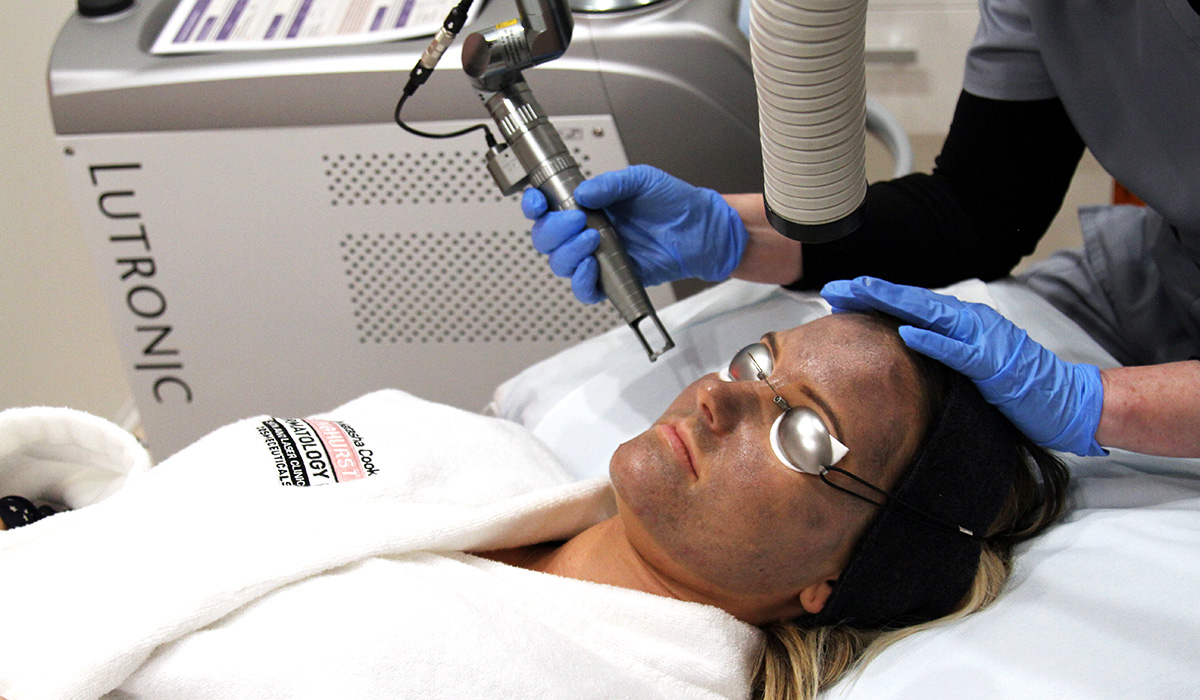
Hollywood Laser Peel — clarity and glow. A carbon layer is applied, then lifted with laser energy, taking surface debris and oil with it. Excellent for congested pores and dullness before an event. It is not a melasma treatment and can aggravate it.
RF microneedling — firmness and scarring. Needles deliver radiofrequency into the dermis, so RF microneedling reaches depth for laxity and scars while sparing the surface. It pairs well with topical exosomes and polypeptides applied straight after, and sits closest to fractional resurfacing in what it can achieve.

If you are weighing needling against laser specifically, our comparison of microneedling treatments covers where each one stops being the right tool.
What does a resurfacing plan cost, and what drives the price?
Three things move the number: how much of the face is treated, how many sessions the plan needs, and whether the treatment is ablative or non-ablative. Ablative fractional work is priced per session and there are few of them; non-ablative protocols are priced as packages because the result comes from the course, not the visit. Because the plans differ so much by skin, the figures below are current package pricing for our in-clinic protocols, confirmed at your free consultation.
At IPL Lab, a fractional laser treatment session is available as a partner service within our Imperfections Deluxe Glass-Skin protocol. That package is mix-and-match: you switch across premium options each visit — RF microneedling with exosomes and ultra-intensive PDRN from Italy, a fractional laser session, and other advanced treatments — rather than committing to one modality before anyone has assessed your skin.
Most popular
Imperfections Deluxe Glass-Skin · 6 sessions
from $200/session
Best value
Imperfections Deluxe Glass-Skin · 10 sessions
from $150/session
Promotional pricing changes, so confirm the current figure on each product page or at your consultation. The full range sits in our skin rejuvenation packages.
What makes a resurfacing plan at IPL Lab different?
We are a medispa, not a laser showroom, and the honest version of our position is this: we do not push every client toward the most aggressive available treatment, and we say plainly when a fractional laser session is delivered through a partner rather than performed in-house. What we own is the assessment and the plan around it.
🔍
Assessment before modality
Your consultation is free and it decides the route. Fitzpatrick type, pigment history, medication and downtime tolerance come before any device is named.
🇮🇹
Topical boosters, never injected
Exosomes and ultra-intensive PDRN are applied topically after microneedling, which is how they are legitimately used. No exosome product is approved for injection in Canada.
🔀
Mix-and-match packages
The Deluxe protocol lets you switch treatments between sessions, so the plan can follow your skin’s response instead of a contract signed on day one.
📍
Two locations, one standard
Certified technicians and Health Canada approved equipment at both our Plateau and Laval clinics.
🗓️
Seasonal honesty
We will tell you to wait. Resurfacing into a Quebec summer, or two weeks before a beach holiday, is how good results get undone.
💬
Clear limits
If your concern is melasma, or your medication rules out resurfacing, we say so and redirect — including to a professional facial when that is genuinely the better step.
Ready when you are
Your skin analysis and consultation are always free.
Medical disclaimer: this article is for general information only and is not medical advice. Laser resurfacing carries real risks including infection, scarring and pigment change, and individual results vary. Consult a qualified professional to determine whether resurfacing is appropriate for your skin, and see a dermatologist for any medical skin condition.
IPL Lab Medispa
Locations
Two clinics — one in Montréal, one in Laval — both offering laser skin rejuvenation, RF microneedling and our full range of medical spa treatments, with street and free parking nearby.
📍 Montréal — Plateau
In the heart of the Plateau, street parking nearby
📍 Laval
Easy access, free parking
Book online
Medical spa
- ✓ Free consultation & skin analysis
- ✓ Two locations — Montréal & Laval
- ✓ Trained estheticians
- ✓ Flexible packages & memberships
Book a free consultation, explore our services, take advantage of package deals in our online store, and discover our flexible memberships. Looking to advance your career? Explore our aesthetic school.