Which skin booster is right for you depends on what your skin is short of: repair signals, hydration, firmness, energy or structure. Exosomes, PDRN, PLLA, NAD+ and peptides each answer a different one of those, and all of them are only as useful as the delivery method underneath them. That is why every booster we offer rides on microneedling Montreal clients already know, and why our exosomes Montreal program is built as a menu rather than a single miracle serum. This guide walks through each booster honestly, what it can and cannot do, how the Italian V-Tech system from Promoitalia fits in, and which one makes sense for which concern.
“The needle builds the collagen. The booster decides how comfortably, how quickly and how evenly your skin gets there.”The IPLLAB skin-booster philosophy
✦ The short answer
Exosomes for overall renewal and calm recovery. PDRN for repair, redness and reactive skin. PLLA for early-to-moderate laxity where firmness is the goal. NAD+ for dull, tired-looking skin, with the youngest evidence base of the group. Peptides (including copper peptide GHK-Cu) for hydration, tone and a gentle first step. V-Tech from Promoitalia combines PDRN, synthetic exosomes and biomimetic peptides in one Italian system delivered with microneedling and fractional RF. All are topical, never injected, and all work through the micro-channels a Derma Pen creates. Courses run $450 to $1,500 depending on booster and session count.
What this article covers
How does a topical skin booster actually get into the skin?
On intact skin, almost none of it does. The stratum corneum, the outermost layer, is built to keep large molecules out, and exosomes, DNA fragments and most peptides are far too big to pass through on their own. That is the whole reason skin boosters are paired with microneedling: the needles create thousands of temporary micro-channels, a few hundred microns deep, that stay open for a short window after the pass. Applied in that window, a booster reaches the upper dermis instead of sitting on the surface.
It matters to be precise about the word “topical” here. In Canada, a skin booster applied to needled skin is a cosmetic-grade product used to support a procedure. It is not an injectable, it is not a drug, and it should not be sold as either. The distinction is not a technicality. Injected exosomes from unregulated sources are where the serious adverse events in the literature come from, and the FDA has issued a consumer alert about exactly that. Everything described below is applied to the surface after needling, full stop.
Because the delivery step is the same for every booster, the real decision is what you put in the channels. The rest of this guide is about that choice.

What are exosomes, and what do they actually do on skin?
Exosomes are tiny vesicles, roughly a thousandth the width of a hair, that cells use to send instructions to one another. Packed inside are growth factors, proteins and short RNA sequences that can nudge nearby cells toward repair, calm inflammation and support collagen production. In a skin-booster context, the exosomes are either derived from cultured cells (typically plant or lab-grown human cell lines in the Korean products we use) or built synthetically to mimic that signalling, as in the Italian V-Tech line.
The honest evidence picture: early. Preclinical work and a growing set of small case series and split-face studies are promising for texture, redness and post-procedure recovery, and systematic reviews published in early 2026 said the same thing while calling for larger, better-controlled trials. PRP, by comparison, has a longer track record in randomized studies. So we position exosomes as an enhancer of what microneedling already does, not as a treatment in their own right. If you want the deep dive, our companion article on what exosome therapy is and whether it works goes into the research in more detail.
🧬
What they help with
Faster settling after needling, more even tone, softer fine lines and a general “rested” quality that clients notice from the second or third session.
⚖️
What they don’t do
They don’t add volume, they don’t replace a filler or a lift, and no exosome product is approved for injection in Canada or the United States. Topical, microneedling-assisted, only.
🌏
Korean vs Italian
Our standard exosome course uses Korean and Italian formulas chosen by skin type. V-Tech (below) is the Italian system that adds PDRN and peptides to synthetic exosomes in one protocol.
What is PDRN, and why is it called the “repair” booster?
PDRN stands for polydeoxyribonucleotide: purified fragments of DNA, extracted from salmon, that happen to be structurally very close to human DNA. Skin cells recognise those fragments and respond by ramping up repair activity, which is why PDRN has a long history in wound care before it ever appeared in aesthetics. In the booster world it earns the “repair” label because the effect people notice first is not plumpness but calm: less redness, faster recovery, a more settled barrier.
Two things to know before you choose it. First, topical PDRN applied through micro-channels is a cosmetic product and is far milder than the injectable PDRN skin boosters marketed in Korea and Europe as “salmon DNA injections,” which are a regulated clinical procedure we do not perform. Second, it is salmon-derived, so it is not vegan and not suitable if you have a fish allergy. Ask, and we will swap it for a plant-based alternative.
Who PDRN suits best
Where it sits in our menu
What is PLLA, and how is topical PLLA different from the injectable?
Poly-L-lactic acid is a biostimulator. Rather than filling or hydrating, it prompts fibroblasts to build new collagen gradually over the weeks that follow treatment, which is why its results arrive quietly and keep developing after the course ends. It is the booster we reach for when the complaint is “my skin has lost its snap” rather than “my skin looks tired.”
The distinction that matters most: the PLLA we use is a topical complex delivered through micro-channels by a Derma Pen. It is the same molecule as the injectable PLLA fillers used by physicians for deeper volume restoration, but it is a different procedure with a different depth, dose and risk profile. Injectable PLLA is a reserved medical act in Québec and is not something an esthetic clinic performs. We say this plainly because the two are often blurred in marketing, and someone expecting filler-level volume from a topical booster will be disappointed. What you get instead is a progressive firming that suits early to moderate laxity along the jawline, cheeks and neck.
What does NAD+ do for skin, and how good is the evidence?
NAD+ (nicotinamide adenine dinucleotide) is a coenzyme every cell uses to generate energy and run its repair machinery, and its levels decline with age and UV exposure. The theory behind NAD+ boosters is simple: give tired skin cells more of the fuel they need, and they repair more efficiently. In practice, clients choose it for dull, “flat”-looking skin, fatigue-related sallowness and the kind of complexion that no amount of sleep seems to fix.
Here is where we are careful. NAD+ as a topical booster is the newest and least studied item on this list. Most of the supporting science concerns cellular NAD+ biology, oral precursors like NMN and NR, or in-vitro work; controlled studies of topical NAD+ delivered by microneedling are limited. We offer it because it is well tolerated and clients report a brightness they like, but we will not tell you it rebuilds collagen or reverses ageing, because nobody has shown that yet. Treat it as a finishing booster, layered onto exosomes or peptides, rather than the reason to book.
Which peptides are used in skin boosters, and what is GHK-Cu?
Peptides are short chains of amino acids, small enough to be absorbed through micro-channels and specific enough to carry a single “message” to skin cells. Signal peptides tell fibroblasts to make more collagen and elastin; carrier peptides deliver trace minerals the skin needs for enzyme activity; neuro-inhibiting peptides soften expression lines by quieting the nerve-to-muscle signal a little. A good booster blend layers several of these, and the ones described as biomimetic are engineered to mimic sequences the skin already recognises.
GHK-Cu, the copper tripeptide, is the best-known carrier peptide and the one people search for by name. It binds copper, which fibroblasts need to cross-link collagen, and it has a genuine research history in wound healing dating back decades. It is a strong ingredient for tone, hydration and a general “healthier skin” effect. What it is not is a lift: on its own, GHK-Cu will not tighten lax skin the way PLLA is designed to. If you have read about it and want it in your course, ask which peptides are in the blend at your consultation; our polypeptide protocol is customised to the skin in front of us.

Because peptides are gentle, well tolerated and comparatively affordable, the polypeptide course is our usual recommendation for a first microneedling series, for younger skin that wants prevention rather than correction, and for anyone who wants to see how their skin responds before committing to exosomes or PLLA.
What is V-Tech from Promoitalia, and how is it different?
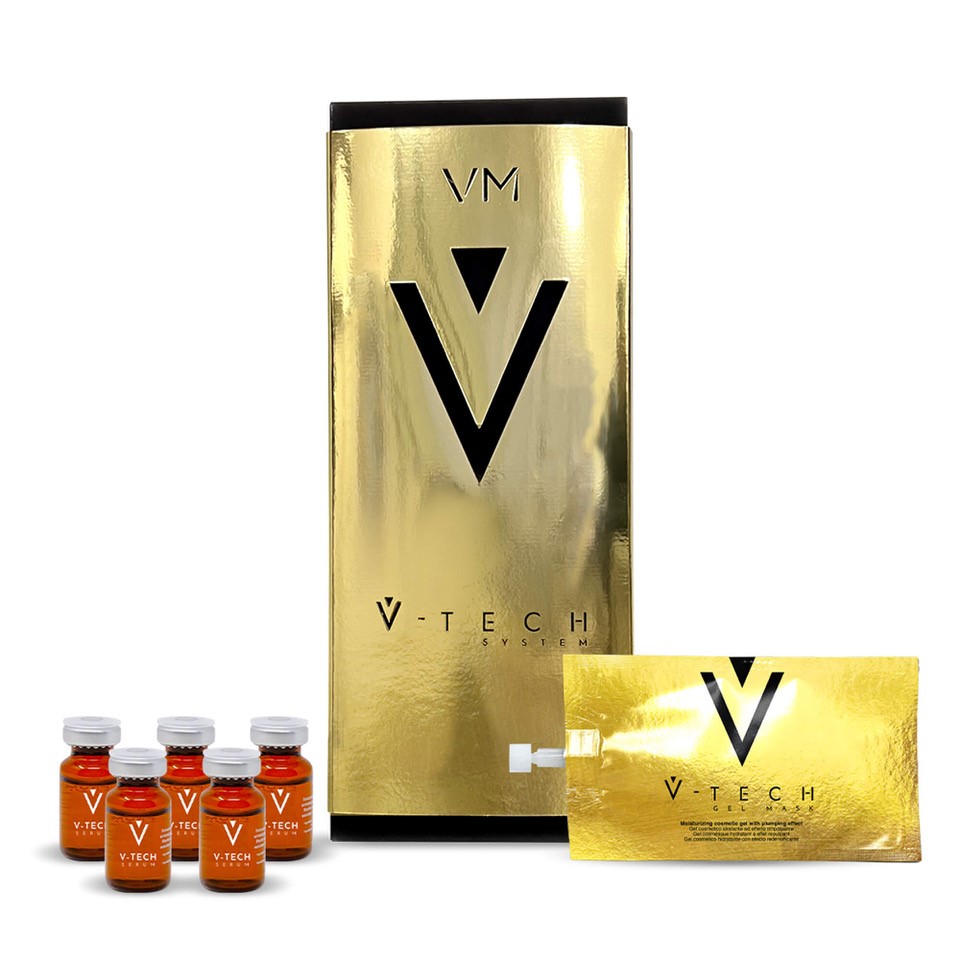
V-Tech is a professional skin-renewal system made by Promoitalia, an Italian aesthetic-medicine manufacturer, and it is the one genuinely different protocol on this page. Where our standard exosome course is a Derma Pen plus a single booster, V-Tech pairs microneedling with fractional radiofrequency and delivers a concentrated ULTRA INTENSIVE serum that combines PDRN, synthetic exosomes, biomimetic peptides and plant-derived stem-cell extracts in one formula. It is Italian, not Korean, and it is not related to the VT Cosmetics K-beauty brand people sometimes confuse it with.
The radiofrequency is what changes the character of the treatment. RF heat in the deeper dermis adds a tightening stimulus on top of the mechanical needling, so V-Tech tends to suit skin that wants both texture correction and a firming component: post-acne scarring with some laxity, enlarged pores plus early jowling, or a generally “tired” complexion in the 40s and 50s. Sessions are spaced three to six weeks apart, longer than the standard course, because the RF component asks more of the skin between visits.
Korean exosomes — renewal and calm. Derma Pen delivery, sessions two to four weeks apart, optional PDRN or NAD+ layer. The most popular course and the most flexible: three, six or ten sessions, face, or adapted for lips and scalp. Best for overall texture, tone and recovery.
V-Tech — renewal plus firming. Microneedling with fractional RF and a combined PDRN, synthetic-exosome, peptide and plant stem-cell serum. Sessions three to six weeks apart, three or six per course. Best for scarring or pores with early laxity, and for skin that wants one comprehensive protocol.
Polypeptides — the gentle entry point. Derma Pen delivery with a customised peptide blend, sessions two to three weeks apart. The most affordable course and the usual first series. Best for hydration, tone, prevention and finding out how your skin responds.
Promoitalia also makes LightEYES, the professional under-eye cocktail (hyaluronic acid, vitamin C, green tea, Ruscus aculeatus) we use for dark circles and puffiness. It is a booster rather than a full needling treatment, applied through a gentler multi-step protocol built for the thin skin around the eyes, and it appears in the price section below for completeness.
Which skin booster is right for you? A concern-by-concern guide
Most people do not need to memorise the biochemistry. They need to match a concern to a booster, and then let the consultation refine it. This is the table we use at the clinic, simplified.
✨
Dull, uneven, “tired” skin
Exosomes first, NAD+ as the optional layer. Peptides if budget or sensitivity is the priority.
🌡️
Redness, reactive skin, slow healing
PDRN layered on exosomes. Shorter needles, longer gaps, patch test first.
📐
Early laxity, soft jawline
PLLA, six sessions. If texture is also a problem, V-Tech covers both in one protocol.
🕳️
Acne scars, enlarged pores
V-Tech or RF microneedling; exosomes to speed recovery between sessions.
👁️
Dark circles, under-eye lines
LightEYES under-eye course. Exosomes on nano needles if lines are the main issue.
💋
Thin, dry or lined lips
Lip needling with exosomes and peptides, NAD+ optional. Hydration and definition, not filler volume.
Two combinations we steer people away from: stacking every booster in one session (more is not better, and it makes it impossible to know what worked), and choosing PLLA when the actual complaint is redness or dullness. Firmness is the slowest result to appear, and a client who wanted glow will not be patient enough to see it.
Is microneedling with a skin booster safe, and who should wait?
Microneedling itself is a well-established procedure with a good safety record when it is done with sterile, single-use cartridges by a trained operator. The booster layer adds two considerations: what is in the product, and how it is regulated. On the first, we use products with full ingredient lists, we patch-test anyone with a history of reactivity, and we treat salmon-derived PDRN as a declared allergen. On the second, Health Canada draws a line between cosmetics (topical, appearance claims) and drugs (injected, therapeutic claims), and every booster we use sits firmly on the cosmetic side of that line.
The one place to be extra deliberate is radiofrequency. In October 2025 the FDA issued a safety communication about RF microneedling devices after reports of burns, nerve injury and scarring, and the American Academy of Dermatology responded with guidance on training and device settings. That applies to the V-Tech protocol and to standalone RF microneedling, not to Derma Pen courses. It is one of the reasons we keep conservative settings, longer intervals and a consultation before every RF-based plan.
Who isn’t a candidate right now
What “topical, not injected” means for your risk
Aftercare that actually matters
How much does microneedling with a skin booster cost? Every package
Pricing follows the booster and the number of sessions, and every course below is sold as a package because a single session of any booster shows you very little. All prices are current at the time of writing and are confirmed at your free consultation; each row links to its own product page.
Face — full-face booster courses
Most popular
Microneedling with exosomes
from $120/session
Deluxe · Italy🇮🇹
Microneedling with V-Tech exosomes
from $250/session
Best value
Microneedling with polypeptides
from $90/session
Targeted zones — lips, eyes, scalp
Lips
Lip microneedling with exosomes & peptides
from $90/session
LightEYES · Italy👁️
Under-eye brightening (LightEYES)
from $150/session
Scalp
Hair restoration with exosomes & peptides
from $120/session
Radiofrequency microneedling — needling plus heat
PDRN, NAD+ and GHK-Cu are add-on layers or components of the blends above rather than separate packages; ask at consultation and we will price the combination. If you are deciding between a Derma Pen course and RF, our comparison of Dermapen microneedling versus RF microneedling lays out the trade-offs, and our microneedling before-and-after guide shows what a realistic timeline looks like. Members save on every course through our membership.
What makes a skin-booster course at IPLLAB different?
Three things, and none of them is a secret ingredient. First, we treat the booster as a choice, not a default: a consultation and skin analysis come before any course, and the booster is picked for the concern rather than sold as a bundle. Second, we are precise about what we do and do not do. Everything is topical and microneedling-assisted; we do not inject exosomes, PDRN or PLLA, we do not claim outcomes the research has not shown, and we tell you which treatments belong at a physician’s office instead. Third, we carry both a Korean exosome line and the Italian V-Tech and LightEYES systems from Promoitalia, so the recommendation can be driven by your skin rather than by whichever product happens to be on the shelf. Sessions are performed at our Plateau and Laval clinics by estheticians trained on every protocol, with the same sterile single-use cartridges and the same free consultation, and pricing is the same at both locations.
🔍
Skin analysis first
Free, before any course. The booster is matched to what the analysis shows, not to a package name.
🧾
Full ingredient transparency
Every booster’s INCI list is available on request. Salmon-derived PDRN is declared, and vegan alternatives exist.
📚
We teach this
Our esthetician school trains practitioners in microneedling and boosters, so protocols are documented, not improvised.
Not sure which booster is yours?
Your skin analysis and consultation are always free.
Sources: U.S. FDA — Consumer alert on regenerative medicine products including stem cells and exosomes · American Academy of Dermatology — Microneedling can fade scars, uneven skin tone and more · American Academy of Dermatology — Statement on the FDA safety briefing about RF microneedling risks
Medical disclaimer: this article is for general information only and is not a substitute for a professional consultation. Skin boosters described here are topical cosmetic products applied after microneedling; they are not injectables and not medical treatments. Suitability, settings and expected results depend on your individual skin and health history — always confirm your plan with a qualified provider.
IPLLAB Medispa
Locations
Two clinics — one in Montréal, one in Laval — both offering the full skin-booster menu, RF microneedling, facials and our full range of medical spa treatments, with street and free parking nearby.
📍 Montréal — Plateau
In the heart of the Plateau, street parking nearby
📍 Laval
Easy access, free parking
Book online
Medical spa
- ✓ Free consultation & skin analysis
- ✓ Two locations — Montréal & Laval
- ✓ Trained estheticians
- ✓ Flexible packages & memberships
Book a free consultation, explore our services, take advantage of package deals in our online store, and discover our flexible memberships. Looking to advance your career? Explore our aesthetic school.